Entries in art quilts (5)

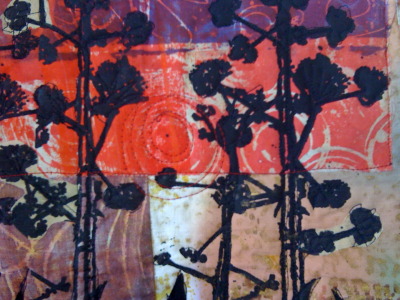
How to make an art quilt if you're me


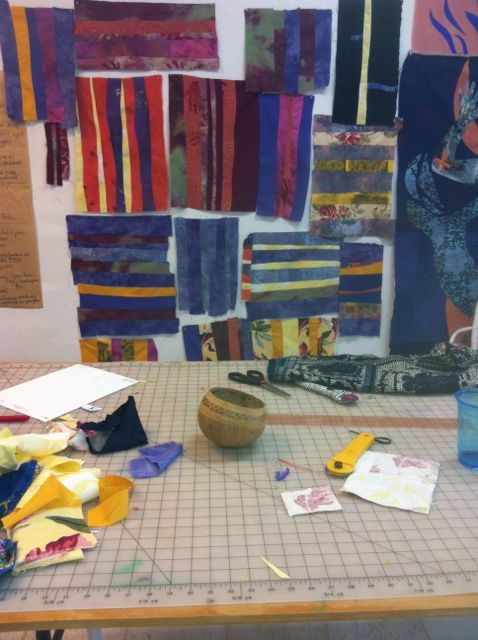
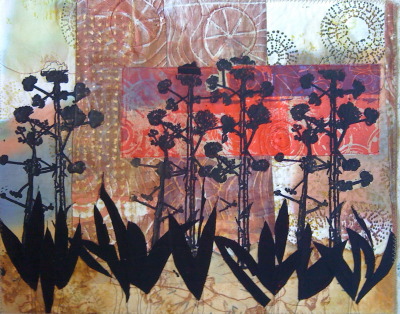
Start with color.


I do this a lot. Over and over. Til its right from the beginning. And yes, the studio stays a mess til this part is done.

(and a bit of a notion of an idea, theme, relation to something earlier done)

Continue with shape and composition.

Work from strong suit to strong suit.

Keep it on the table until it's together enough to put on the wall.

(Where I am now.)

Pin up and look. Keep it up. (still to come)

This pomegranate virgin is in my heart, singing of abundance, life force, generousity of spirit. I am holding her in my heart right now.

What is your process? Where is your strong suit? Do you let yourself start there or try to follow someone else's formula for success. I think your main task as an artist is to discover those gifts, honor them, and let them lead your process. Don't believe other people's formulas. Maybe you try them out to see what works and not, but in the end, just as you stitch together your cloth, you stitch together your way  of working. It will be as unique and as personal and as much a part of your "voice" as any other aspect of visual style or content.

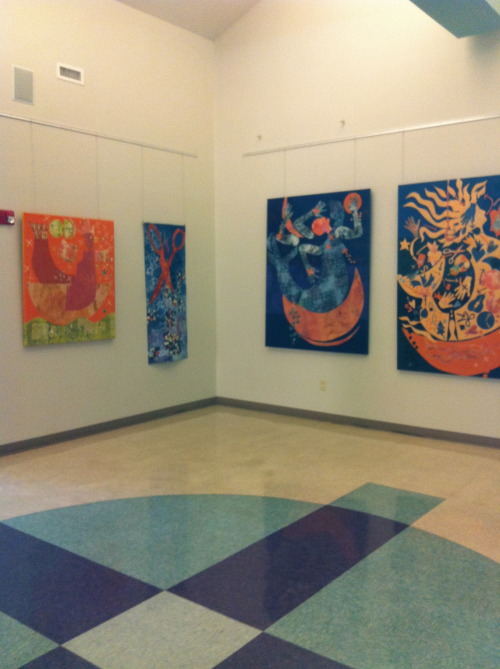
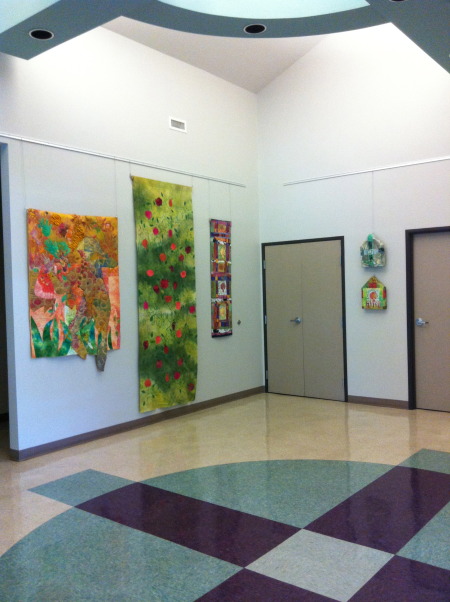
Art Quilts at Baylor

Jack Brockette sent along this photo -- his wife Ann took it, I think.

This exhibit at Baylor University's Martin Museum is up through the weekend, Nov. 14. If you are in Central Texas, please stop in and see the wonderful and diverse work by the participating artists: (in no particular order) Jack Brockett, Sue Benner, Liz Axford, Connie Scheele, Jane Dunnewold, Ann Adams, and me. I am honored to be included in such a group of stellar artists!

The exhibit was curated by Mary Ruth Smith, who is on the faculty at Baylor, and beatifully installed by the museum staff headed by Karin Gilliam. We were hosted by the university at a luncheon and lecture by Kay Lenkowsky, quilt artist and author of Contrmporary Art Quilts. It was a treat to meet her, and to spend time with all of these talented artists. Our work is so different and the exhibit revealed much to the local audience -- many of whom I think had never seen a quilt that wasn't made for a bed.

I grew up from age 12 to 18 in Waco, so it was a particular treat for me to be part of this show and to have all my family and relatives there able to attend. My father taught at Baylor for many years, my uncle was a dean and VP and my aunt also taught there, plus brothers and sister-in-laws, all are grads. My parents don't travel much anymore, so it was really wonderful to have them attend the reception.

Here are a few pictures from the reception:

Kate and Liz deep in talk.

 You can catch a glimspe here of Jack's hanging work and Jane Dunnewold's piece on the wall.

Here's a few other pictures from artists who participated, with their permission:

Sue Benner's "Cellular Structure VII"

Liz Axford's "9-patch" take with felted stitched work:

Posted on Wednesday, November 11, 2009 at 09:03AM by Registered CommenterSusie Monday in , , , , | Comments4 Comments

Another Artist Profile

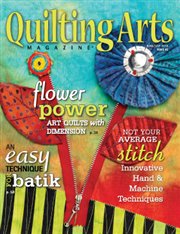
I have had my third artist profile published in Quilting Arts Magazine this month -- it's about Cathy Kleeman and deals primarily with her right-brain/left brain balancing act as an artist. I've enjoyed talking to the artists whom I've interviewed for the  past three issues -- and the good news is that I'll have an article about my "rainbow" prints with water color crayons and polymer in an upcoming article, the first writing I've done for QA that will be about my own work!

But, since this one was also the cover story, that's a pretty nice accomplishment, too!


Posted on Monday, September 21, 2009 at 07:03PM by Registered CommenterSusie Monday in , , , , | Comments6 Comments

What is an art quilt?


Everytime I think that surely the whole world is into art quilts I meet someone who looks puzzled and asks me "huh?" Quilts hung on the wall is sort of part of it, but many people also hang their "traditional" quilts on the wall. And, frankly, I'm not so sure that the borderline between traditional and art quilts is all that clear in the minds of many who even like to tinker in the trappings.

I certainly don't want to replay the whole art vs. craft discussion here, nor do I believe that we gain a lot by debating what exactly is art -- it's a lovely question that's been asked and answered for ages. (I personally like what Rudyard Kipling wrote in 1890 in Conundrum of the Workshop:


“When the flush of a new-born sun fell on Eden’s green and gold,
Our father Adam sat under the tree and scratched with a stick in the mould;
And the first rude sketch that the world had seen was joy to his mighty heart,
Til the Devil whispered behind the leaves, “It’s pretty. But is it Art?”

But I do think its worth stating and restating a few times on this blog, one the purportedly is about the studio life, practise and output of an artist who makes art quilts (aka contemporary textile paintings) and during this season of entry forms (esn't every season now?) it's nice to revisit what some of the "big kids on the block" have to say about it.

Here's Lisa Call's take on the topic, from her Squidoo lens (and she quotes and attributes several others):

What is a Contemporary Art Quilt
From Lisa Call’s http://www.squidoo.com/artquilts/

There is a lot of discussion in the art quilt world about what exactly an "art quilt" is and what we should call them. The simple term "quilt" is deemed unacceptable by a large portion of the general art quilting population because of the connotations of traditional quilt that it carries with it. So most people prefer to add some type of disclaimer to qualify the type of quilt they make.
One of the more common terms is "art quilt". I prefer "contemporary quilt". Some people say "fiber art" or "studio quilt" or "textile art" or "soft painting". But the question remains - exactly WHAT is a contemporary art quilt? Generally it refers to a quilt that was intended to be art and hang on the wall vs. placed on a bed. Although some art quilts might also be bed quilts.

What is Art?
As contemporary art quilts are "art" it's good to think about what art is when trying to define them. Of course defining art is difficult but the definition I prefer I read on Alyson Stanfield's Art Biz Blog

"What is art? . . . art is the deliberate creation of aesthetic sensations. Art is a work of a human being, not of nature. It is not accidental. It produces something that is perceived through the senses and results in a personal emotional experience. . . .

". . . it is the conscious, deliberate production of an event or object of beauty (or emotional import) by a human being, employing not only the skill of the craftsman, but in addition, an element of creativity--original, inventive, instinctive, genius. An art object is an aesthetic artifact, deliberately created.
Art actually lies in the act of creation, not in its result."

--G. Ellis Burcaw, Introduction to Museum Work, page 66

Definition of an Art Quilt
From the "Authorities"
This is Quilt National's definition:
The work must possess the basic structural characteristics of a quilt. It must be predominantly fabric or fabric-like material and must be composed of at least two full and distinct layers - a face layer and a backing layer. The face layer may be described by any or a combination of the following terms: pieced, appliqued, whole cloth, stitched/fused to a foundation. The face and backing layers must be held together by hand- or machine-made functional quilting stitches or other elements that pierce all layers and are distributed throughout the surface of the work. At least some of these stitches or elements should be visible on the back of the work. As an alternative, the work may be a modular construction (an assemblage of smaller quilts). Each individual module, however, must meet the above structural criteria.

This is Studio Art Quilt Associates's definition:

SAQA defines an art quilt as a contemporary artwork exploring and expressing aesthetic concerns common to the whole range of visual arts: painting, printmaking, photography, graphic design, assemblage and sculpture, which retains, through materials or technique, a clear relationship to the folk art quilt from which it descends.

The art part of the definition is the most debateable, and as Kipling wrote, a longtime call and response.

The majority of Westerners today, if a survey of more than 500 people conducted by Carolyn Boyd’s anthropology class at Texas A&M has any validity, think that


“art is created for the sole purpose of being aesthetically pleasing to people within society and with minimum purpose beyond that of intrinsic enjoyment.”

Boyd is studying the rock art paintings of the Pecos River and, she views those great works in a somewhat different light, one that does not make them ART at all, but something more utilitarian than what that survey indicates most Americans think about art.

Human beings are makers – we evolved these opposable thumbs and then just couldn’t help but start making tools, making clothing, making shelter, making food fancier, making stuff.

As we developed more skills and fancier tools --and perhaps the time to spare, we started pleasing our senses with the things we made --adding aesthetic considerations to their functionality with decoration, embellishment – and also just with making things that had inherent sensory-pleasing qualities of texture, color, shape and form. This concern, these considerations have changed, but endured even into the industrial and post industrial, electronic world. Craft and technical skills become valuable.

We make stuff – and try to make it pleasing --but we humans also make stories. As story makers, we are as concerned with the why and how come and what happened then and what happens next as we are with making our lives run more smoothly. A story, in this broad artspeak meaning, can be a narrative, a question, a confusion, a conversation between formal elements like line and color, a public outrage, a private history -- and it can be done well or poorly.

And to me that’s where the art comes in to the quilt.

Page | 1 | 2 | Next 4 Entries