Entries in Workshops (36)
5 Ways to Jumpstart your Creativity, Pt. 4

4. Travel.
OK, every year can't bring a capitol letter Vacation (like last year's 3 week trip to northern Italy). Every month can't include even a weekend outing to someplace a bit closer to home (though I apparently think so with April's trip to Rockport, June's to Corpus Christi and this month's trip to see my sister in Salida, CO). BUT, even with gas prices what they are (and I don't want to hear another word about that as long as y'all are out there drinking bottled water), travel is truly broadening and amazingly good for the creative juicer whether it's in real time and space or a virtual trip across the universe via web sites and other-people's-trips.
Think about these possibilities:
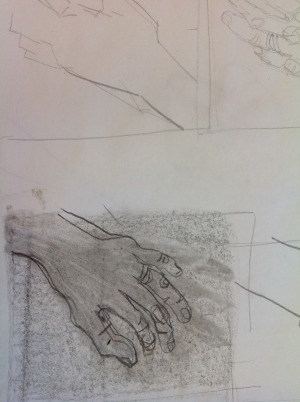
First of all, whichever trip you take, take a sketchbook and journal, ideally a digital camera, along with you. Collect ephemera and souvenirs, take photos, better still sketch and watercolor, interview the experts and the locals. Be adventurous. Don't stick to the tourist destinations, but find out how people live, what they create with their hands, what is eaten, what it' s like to live under that sun. Write in a cafe or under a tree. People watch. Try the contour drawing trick (Pt. 2 of this series.)
Then:
Prowl the downtown and tourist destinations in your own community. I am never more flabbergasted than when I ask San Antonio residents how recently they have visited the San Antonio Missions National Historical Park and hear that its been a.) years, or b.) never. Hey, some people pay big money and take lots of time to come visit some place you drive by every week. One little day trip or weekend outing can cost little in time and give you an enormous boost to creative visioning when you travel with that intent in mind. You can even take public transportation to a lot of these sites.
Choose a country, city, natural wonder or other vacation destination to study for a month or a season or even a year. Pick some place that fascinates you for its visual, historical or symbolic power. Check out books from the library, even audio tapes and movies. Go to museum exhibits and concerts that originate in your vacation place. Learn a little of the language. Start an imaginary itinerary. Keep a travel journal "as if." Draw from photographs, literally and figuratively for your muse.

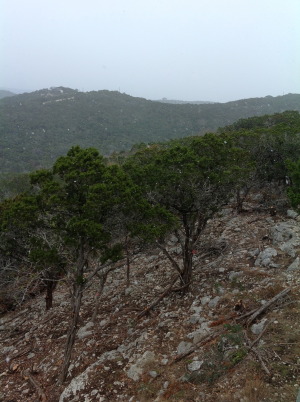
Spend just a weekend at a retreat center, state park, or natural area, or an out-of-town workshop venue (like my El Cielo Studio retreats), or some place else that takes you away from your ordinary day and your ordinary city/suburban life. The place might be a spa, it might be a swimming hole or a river raft trip. If you can't afford to go further, spend an entire day at a city park. Take food, drink, books, a quilt to lie upon. Listen, look, experience the weather from dawn to dusk. Live in the natural world, so that means no cell phone chatter, no IM, no radio or ipods. I think of this as a trip away from technology. You can even do it in your own backyard or on the balcony.
Start planning and saving today for that dream trip next year, or the year after. Be realistic, but not too realistic. My experience has been that once I commit to a plane ticket, I will find both the time and the money for everything else, even with the EURO rates lately. It is all too easy to think you'll never have the money or time to see a part of the world that calls to you. First step (if your destination is out of country, get that passport this month). It always helps me to do this one with companions, then its harder to back out.
Eavesdrop on someone else's travel. There are tons of web sites where intrepid travelers tell you all about their wanderings, and then there is Anthony Bourdain, No Reservations on the Travel channel. Another great trip I've taken lately has been with Bill Buford in Heat, a great audio book or read about his education as a cook with Mario Bateli and in Italy. You may notice a trend here, see the next suggestion.
Cook your way around the world. Try a different recipe from a different country each week. Seek out an ethnic grocer if you can in order to buy the ingredients, or order them from an ethnic grocery supplier online. Cooking and art go together in my mind. I think of ingredients the same way I think of colors. I like to look at new ones, and new combinations of them. I eat visually as well as with my mouth. Food is an amazing way to explore another culture, country or part of the U.S.
Then, what to do with all this input. Create with its energy. With the new eyes you had to have. With its content -- sketches, paintings, fabric altars and quilts, photo albums, amazing travel journals. Artist's postcards and ATCs, you'll figure it out!
Update: After Photos
Here it is. Six photos worth a thousand words. (See post before last for the BEFORE pics.)


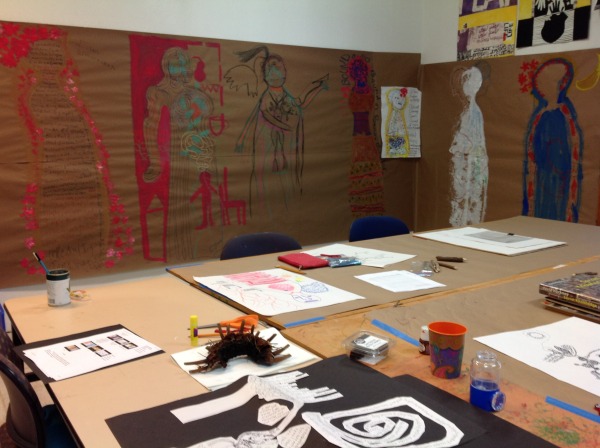
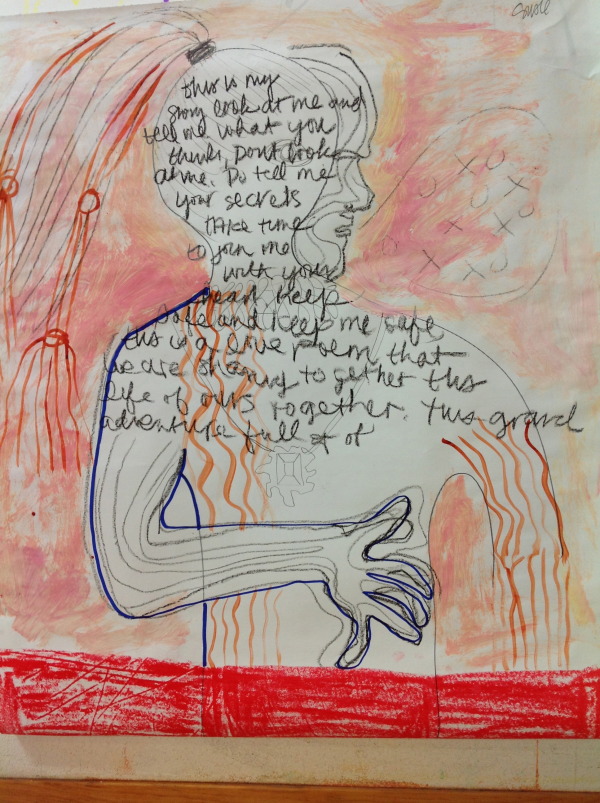
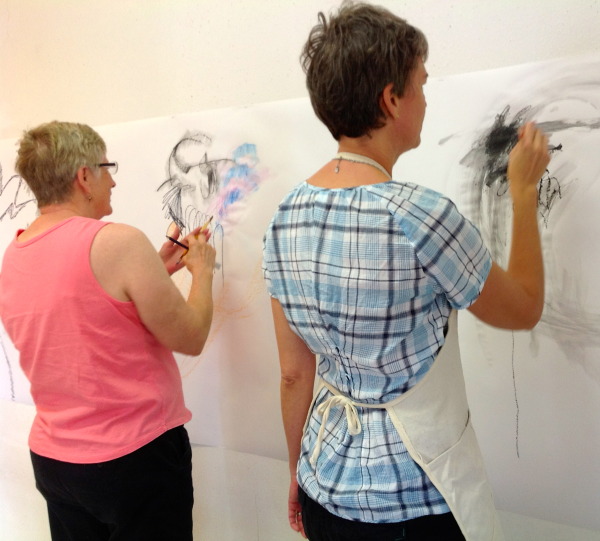
You can see examples of the kinds of projects we'll be tackling in this weekend's Text on the Surface Workshop.
Note: I had a note that the comment section of my blog was acting up earlier. If you had trouble posting, sorry. I think its fixed now.
Getting on Top of the Studio: Organization for Organizationally Challenged

Or is the studio on top of me. Feels that way right now. Those of you who have attended one of my workshops may be under the mistaken assumption that I am a neat and well-organized artist.
Oh, how wrong.
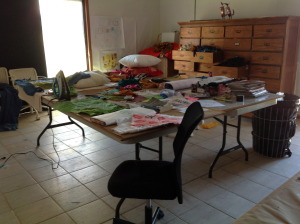
One of the unexpected benefits of teaching in my studio is that I am forced to clean, tidy and organize at least once a month. Pride and necessity coalesce to motivate me before the participants arrive. Truth is, I work with piles of stuff, large piles, scary piles. When I am in the art-making mode, I just can't be neat and tidy. All those mountains of material must magically return to their bottles before anyone else can fit in the space, as large as it is. Having a large studio has been a mixed blessing -- I have room to continue working without cleaning as I go. Great for flow. Not so great for organization. This is not a plea to the universe for downsizing, BTW. I LOVE my studio. But it does look like Vesuvius after the erruption at times (like now).
What does work:
Keeping items in like categories, no matter their end results or techniques. ie all the batik materials together. All the scissors together. All the textile paints together. If I get too fussy about my sorting, I'll spend all my time trying to keep it together. Big lumps of categories work best for me, no alphabetized sortings of dye colors -- though I do write the colors large on the lids, so I don't spend all my time squinting.
The art drawer cabinet is filled with "roughly" sorted colors of smallish pieces of fabric. So if I need a green I know where to go. If I need all the green, I can dump the drawer out on the design table. I don't spend time folding or neatening up these drawers, they are the surprise grab bags of the studio. Larger pieces of fabric are folded (sometimes) and stored in large plastic bins by type -- silks and silky stuff here, florals there, dyed pieces in progress in another, white linens in yet another, clothing to cut up in another. These are a bit unwieldy, but the best system I've found so far. When the lids are down and the bins stacked, the studio returns to visual calm.
I'm lucky, since the space was once a full kitchen, bath and studio apartment to have lots of shelves and drawers for supplies like scissors, dye and paints. The quality of these fixtures is lousy -- drawers are falling apart, hinges are dodgy, and someday I'll have to do a remodel, but for now, it works well enough.
Moving things around as a motivational factor. I don't like things to stay the same forever spacially. I like my desk in different places, the design tables moved around and reconfigures. Some stuff is too heavy to move, but it works for me to rearrange as part of the neatening it all up process.
Paper work also tends to pile up, no matter what "system" I try. A few methods have stuck, but maintanence still takes me longer than I wish it would, and when I'm busy with a production deadline, my "inbox" becomes a nightmare. Here's my paper system for now:
Open file box with hanging folders for my 43 folders. Also three hanging folders for "Read and Review," "Errands," "Dreams and Goals." Anything dated (deadlines, maps, supply lists, appointment papers, etc) goes into the proper day or month folder. And, even if I get behind on sorting -- my May folder items are still waiting to go into the proper days -- this system has been a godsend, saving me hours and hours of looking for lost stuff.
Three small file cabinets that fit under the bar for a.) business paperwork, including workshops and exhibits, b.) household bills and important papers, c.) everything else in alphabetical order, also modeled on David Allen's Getting Things Done.
In the virtual world, I aim for INBOX Zero. That keeps me relatively mindful of what's coming in and going out via email and gets me to tend to little wiggly stuff as it happens. Not that I always achieve it -- but the days are over of finding myself with 478 items in my inbox. I also keep my calendar (one calendar only) on my computer (ical) and copy email dates, appointments, deadlines into it, printing it out about once every two weeks so I also have a hard copy. I now have an iphone and that has helped enormously, because I can carry synced versions of my calendar, my contacts and email along with me.
PS. This whole thing depends on a BIG inbox (a card table actually) where papers, supplies, art etc. coming into the studio lands until I take time to sort it out. At least if it lands in one place, I have a halfway decent chance at finding it if I need something BEFORE I get it back in its home.
Having so nicely listed my ideal, it's time to tackle the actuality. Time to put on HGTV, read a few inspirational organization blogs*, have my Diet Rite cola iced up and ready to go, sset a timer for 1 hour increments (as a reward for each hour of cleaning, I spend 15 minutes doing something more fun) and visualize how nice it will be to have everything back in its place. As additional motivation, I will post some follow-up AFTER photos.
And, if you have any suggestions that might help me tame the beast, please post a comment. I'd also like to hear how other artist's organize materials and supplies. What works for paper, doesn't always transfer to stuff -- and what works for linear thinkers, doesn't always work for us spacial/visual thinkers.
*No time to list more of these now, but I'll add them to tomorrow's AFTER post.
Up on the Majestic Mountain
Just a quick note until I get my long-promised e-newsletter together this week. The beautiful Majestic Ranch Arts Foundation will host a weekly fiber arts class this summer -- hopefully continuing throughout the year. I'll be there for the first six weeks, then Lisa Kerpoe , with her incredible eye for color and art cloth, will teach the second of two sessions.
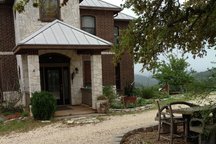
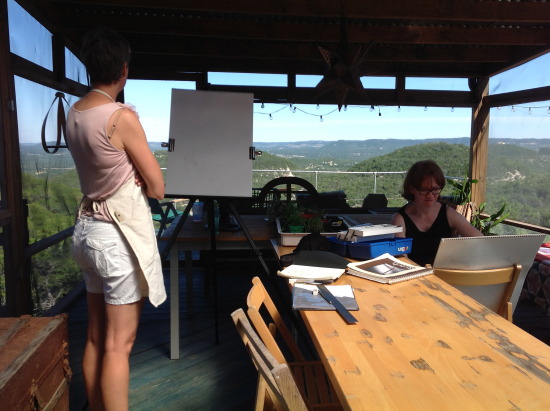
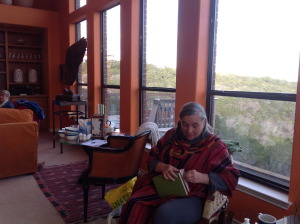
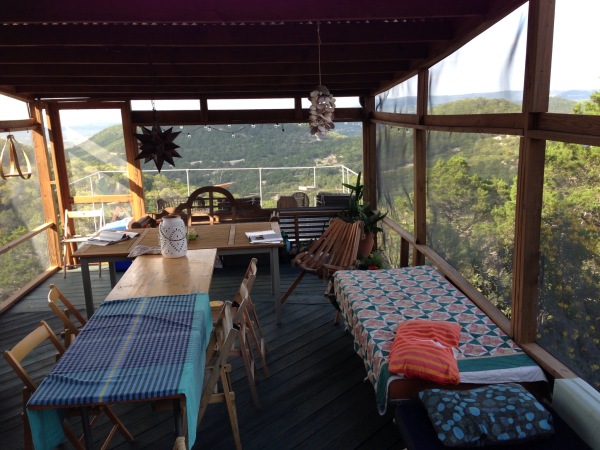
The Majestic Ranch is located at the top of a spectacular hilltop about 5 miles from El Cielo (as the crow flies!), on State Highway 46 between Boerne and Hwy. 16 to Pipe Creek and Bandera. It's a pretty convenient location for those living in Boerne, Kerrville, Bandera, Helotes -- and for those in the city who would like a little country respite each week. For more information, click through on the links above. I hope some of you will be able to take advantage of this wonderful setting and the studio fun with fiber.