Going Far Enough

Detail, Eve Leaves, 2009

In your work.

One of the principle differences I see between "beginners" and seasoned artists is the willingness to go far enough with an idea, a material, a vision, a technique. It's a fact of cognitive psychology that we humans have a interesting condition for learning. We need to have a certain degree of familiarity, safety. And we have to have something that pushes us into new territory, a little risky feeling, an edge of the unknown, a bit of discomfort -- it's called cognitive dissonance.

Sample, watercolor crayon print

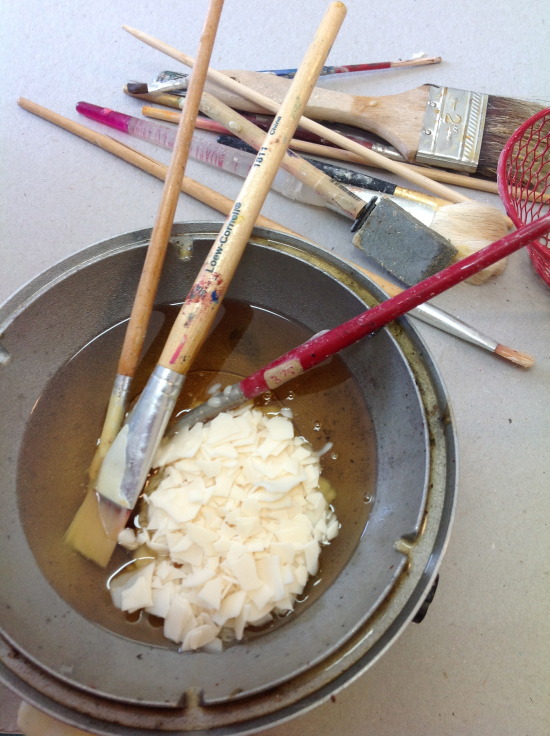
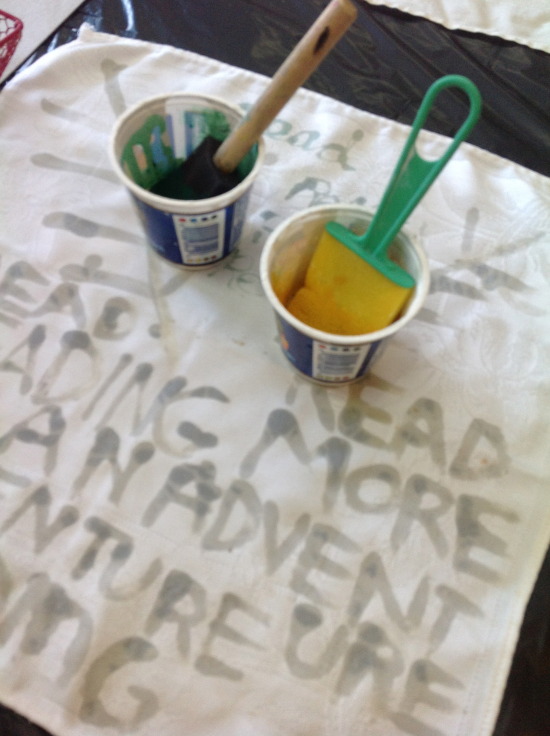
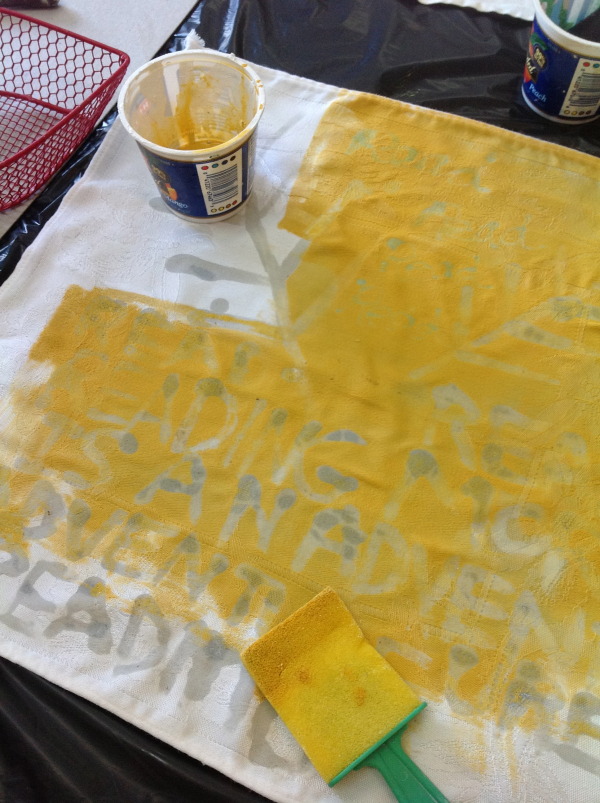
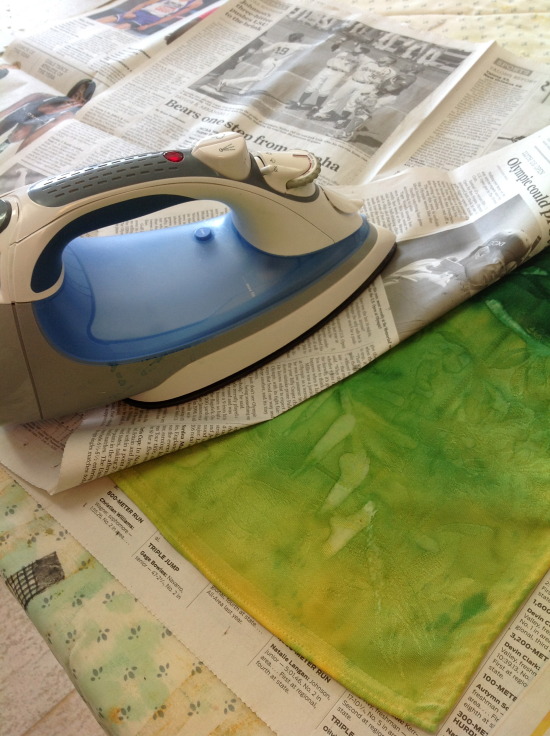
This past week I took a journey into cognitive dissonance. I spent the better part of the week exploring and pushing myself in a familiar arena, using watercolor crayons with gel medium to produce multicolor images -- one of the techniques I've been using since I began working in this field. I had two reasons for the task: I am teaching a one-day workshop at the International Quilt Festival in Houston on Thursday, October 15, "Rainbow Prints with Watercolor Crayons." I wanted to be up to speed with some new media and have some fresh samples and examples to share. (There's still room for a few more participants in this workshop, you can find out how to register by going to website, www.quilts.com.)

Secondly, I am attending a meeting right after Festival of the Art Cloth Network, a small national organization of  about 25 artists who spend dedicated time and energy investigating and creating art cloth, or, as Jane Dunnewold, calls it "complex cloth." Sixteen years ago I began a serious pursuit of my life as a working artist in classes with Jane (and her faculty) at the Southwest School of Art and Craft. My entry into art quilts, where I spend much of my energy now, came after I began making and learning about complex cloth, and I continue in that world with art cloth pieces, and in the surface design that I use for fabrics that become part of my quilts. But over the past few years, I have found myself less myself in my art cloth than I am in my art quilts. I have felt that though my work can be strong, it doesn't have the depth of expression or the true individuality that I think I have found in my art quilts. Much of the art cloth I make ends up being cut up to use in my art quilts, not a bad end for it, but kind of a denial of the art cloth "movement," which promotes the creation of beautiful, artful and meaningful cloth as a end process, not just something to be used for something else. So, I thought that if I took a technique and an image I love, worked with it towards art cloth, I would actually have some fabric I ws interested in to take to the conference for our show-and-tell!

If you are still with me, forgive the long introduction -- but sometimes its good to pinpoint exactly where one is in the process. So the week of work, it worked!

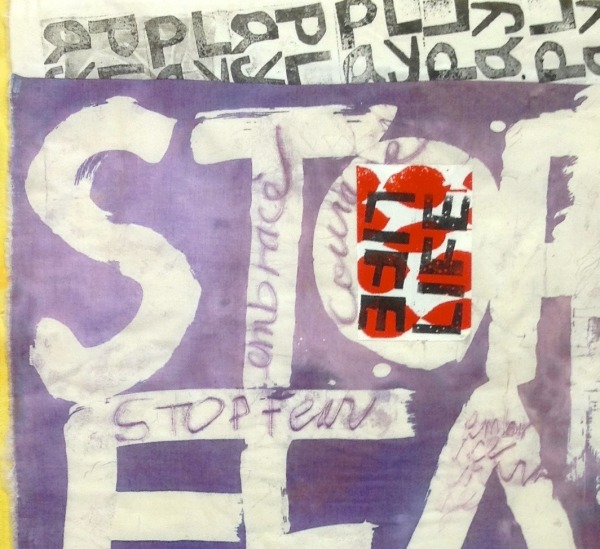
Not only do I have some new interesting media that proved to be easier to use (especially in the IQF setting without cleanup sinks!), some adaptations that make the technique even more interesting and varied, but I also had a breakthrough for my art cloth work. I have discovered a  new direction to follow  for my art cloth that seems to have a relationship to my art quilt work, in that it is more narrative and more "imagetic"  than what I have been doing. You've seen the warmups in samples as you've read this diatribe and here are the first two lengths of art cloth (I confess, I might want to try making a whole cloth quilt with one or the other someday -- also something I've never tried). These are, I warn, Works In Progress. Neither is completely successful as a final art object, but I learned an enormous ammount simply pushing myself into a new realm of work. One question that arises: when does a piece of art cloth become a painting on cloth. Or does that matter? What do you think?

"Eve Leaves," Art Cloth, 2009, mixed media, watercolor crayons, screen-printed"Hummingbird and Century Plant" 2009, Art Cloth, mixed media , watercolor crayons, screenprinting

I've also completed a handout about the technique of using watercolor crayons and polymer medium that I'll use at the Festival. It goes through the basic process and tools for this technique and you are welcome to download it here.  (Link is yet to be figured out. coming soon!) Email me for an attachment pdf to be mailed to you.


Space in Spaces - photos from summer travels

Bus and street reflections, St. Petersburg

SPACE is one of big time favorites.  I work from and within spaces whether I am working on an art quilt, art cloth or, wearing one of my other hats, as a museum and exhibit designer.  As a textile artist, I like working with unusual spaces, and often my work is shaped or irregular, simply because that seems much more interesting to me than a rectangle or square. It may be one of the reasons I like textile arts in general -- the spacial use and ideas are much more diverse than that of the space of a painting -- which is all created by illusion of depth of field -- the one kind of space I'm NOT that interested in.

Here are a few of the photos from this summer's Scandinavian travels that have particularly strong use of SPACE. (This is part of a series of nine photo collections that record different aspects of the Sensory Alphabet -- a tool I use for organizing images, working creatively and collecting input and organizing new ideas.

The British Museum with Kings Crossing in the background

Arcade, St. Petersburg

Berlin, Memorial to the Murdered Jews of Europe


Berlin

Church on Spilled Blood, St. Petersburg

Art Retreat Special, Buy this one, get one half off!

I was late scheduling my September workshop, From Scribble to Symbol, Personal Mark-Making, and now I need at least a couple of more people here for it to be fun (and profitable) for me and everyone participating. So for those who sign up for this workshop (including those who have already registered), pay for the September workshop before Sept. 20, and I'll give you a certificate worth one-half off the next workshop/retreat you sign up for here at El Cielo -- that's an $80 value. This offer is limited to the next four people who take me up on the offer, email me and then send the check! I also take PayPal.

A reminder of what we'll be doing:


In this workshop, start with simple sketches and doodles and end the weekend with an arsenal of new surface design tricks and tools.  Explore doodles and scribbles as sources of unique and personal imagery that will give your art quilts, wearable art, or mixed media work personal depth and layers of meaning. Any artist will benefit from these exercises, whether you make your mark on paper, clay, quilts, art cloth, metal or any other media that has an element of decorative motif or imagetic narrative.

Take a favorite symbol -- for example a heart, star, spiral, circle, leaf, apple -- and by taking it (and yourself) through a series of creative generative exercises, you’ll make something new and different to incorporate into your design, composition and surface design. Then develop something even more personal from the kinds of doodles and marks that show up on your notepads and napkins! Tools and techniques explored include paper lamination on fabric, large scale “mark-making” rollers and monoprinting -- also some hands-on work with some computer programs that you can download for free and use in your image generation process. (bring a laptop if you have one.)

Some examples of some of the kinds of mark-making that I'm interested in are shown below in these photos (the one at the top of the post was developed with a program called SCRIBBLER).

xs and os


Bird of Loss, from hand shape

Pomegranite image - a personal/ universal symbol I use often in my work

30 spokes wheel, symbol developed from a Tao saying

Hear, deconstructed screen print and stitch


Light, illuminating new ideas

Sometime around midnight, somewhere in the Baltic SeaPerhaps the most stunning and interesting photographs from my recent travels in Scandinavia were those with strong LIGHT content -- not only because photography is all about light, but because the quality of those 20 plus hour days of daylight were so potently active as to our psychic relationship to the space and time. Daytime has a much more expansive meaning when the sun "goes down" at about 11:30 pm and rises at 3 am, and truely, it never is really dark. The white nights of Russia, Finland, Sweden certainly color the activity and spirit of the places. Even though we were ship-bound in the evenings and nights due to our sailing schedule, it was easy to see that the lives of all the ports went on way into the wee hours. There were truely more hours in the day to do things and in general, people seemed intent upon enjoyment of all the pleasures of daylight. Guess it shapes your summer when you know 18 hours plus of dark is coming all too soon!

Linda in a Light exhbit at the Design Museum in CopenhagenConservatory at the Sculpture Museum, Glyptotek, in Copenhagen. Along the River Neva, St. Petersburg White Nights

More from the ship